

The Thames held its secrets close. At low tide the river revealed the sculpted silt of centuries and the iron bones of ships that had once been proud, their names long since rubbed away by weather and neglect. Fog smeared the bank lamps into weak moons; the estuary smelled of brine and petrol and the faint iron tang of old metal. In that pallid world, the silhouette of the SS Montgomery lay half-sunken and half-defiant, a dark crown of riveted steel and barnacled ribs that gathered gulls like punctuation. To the casual traveller she was a ruin, a hazard marker on a chart. To those who knew, she was a skeleton of consequence, waiting for the hands that could make her speak again.
Sokolov kept his distance from that intent and preferred the vantage that distance granted him. He sat in the back of a low, windowless van that hummed with the covert hygiene of military movement: quiet engines, papers folded into small stacks, maps annotated in the precise hand of someone who had learned the economy of instruction. He watched the river through a thermal overlay on a tablet, listening not to the screen but to the subtle movement of his team as if sound might carry truths where images could not. The placement of devices beneath a wreck was not merely a physical task; it was choreography of timing, patience, and the currency of denial. That orchestration was his responsibility, and he carried it like a ledger that could never be balanced too soon.
Petrov had been the man Sokolov chose for the job: not the most demonstrative, but the kind whose face registered less than his hands. He had the engineer’s patience and the calm of someone used to working with instruments that demanded faith. He was quiet, methodical; his eyes retained the precise brightness of someone who counted in ratios and tolerances rather than absolutist dictates. Alongside him moved Kor, whose reputation was forged in action rather than rumour. Where Petrov was a metronome, Kor was the sudden bell: decisive, clear, untroubled by the personal narrative of courage. Both had been given the same instruction in different languages of authority: compromise the Montgomery as an option, to deny safe harbour, and thereby impose a strategic constraint on the adversary. In prose it sounded neat. In execution it would not be.
They assembled at the mudline, where the night folded and the shore turned into the first dark fingers of the river. Their approach was not cinematic; it was engineered to be invisible.
The team moved like shadow-touched apparatus: wetsuits under dark coats, zipped helmets tucked like insects against the throat, packs that suggested the forms of tools without explaining them. Kor had checked her kit in the muted way of those with habit rather than thought. Gloves, faceplate, the small latches that turned in the night as if they had the right to. Her breath went out in thin plumes that the river took and swallowed. She let her gaze find the mass of the wreck and run over its hunched angles as a surgeon reads the contours of a patient. The Montgomery was mercilessly practical in her anatomy: hull plates softened by rust, superstructure bowed and caved, portholes glassless and gaping like teeth. It held cavities and hollows that could conceal instruments and offered points of purchase to patient, precise hands.
Petrov’s voice, when he spoke, was low and precise. He ran through the plan as one would read a weather forecast: tides, windows, the likely arcs of patrols. He spoke of complications without theatre. "The flood tide will take us for the next forty minutes. The currents will reverse fast after that. Cameras along the riverbank are intermittent, and there is a blind to the south-east sector. Harbormaster routines give us an hour of lower surveillance." He did not elaborate on sources. Those listening already held the map in their heads.
Kor cut to the nearest reality. "They knew conditions would be poor for visibility. They prepared for contact in silty substrate. Keep to the plan. No improvisation." Her eyes fixed on the water, her face unreadable. Her hands were steady, not because she was unmoved, but because she had learned to invest emotion in technique.
They pushed off from the boat with the small, steady motions of men and women who had rehearsed insertion and extraction in cold circuits of training. The water took them like a patient hand, wrapping them in a cold that reached through neoprene and muscle. The estuary pressed against them, a tide with opinions, sometimes cooperative, sometimes brutal. They descended as if into a muted cathedral, where every sound was the sound of water and instruments breathed out and in.
Underwater, the world rearranged itself. Light, which above the surface was punctuation of the night, dissolved into diffuse glows from headlamps; each beam cut a theatre narrow and absolute. Visibility was measured in the width of a hand. They moved propelled by jet packs through darkness, unseen. The hull of the Montgomery loomed as a vast suggestion rather than a distinct object: a bulwark of dark metal scarred by long decay. The divers moved expertly along the bow, feeling with gloved fingertips the grain of the structure. Petrov worked with the other pair at the stern, skimming the substrate in cautious half-steps, aware of snags, soft pockets of silt, and shards of glass that could slice a suit like paper.
Technical detail could be persuasive in fiction; authenticity was the currency that bought readers’ surrender. Yet technicality that transmuted into instruction would be unsafe and unnecessary. The truth lay instead in sensations: the struggle of breath controlled against the water's claim; the sudden bright acuity of a torch catching an old plate edge; the dull impact of gloved fingers against barnacles; the way mud stuck to fabric and added a weight with little mercy. Kor felt the hull with the same attention she would give a patient wrist: attentive, systematic, cataloguing options rather than divulging them. She found points that would accept attachments: creases and lips where something could be fitted and concealed, catalogued in a precise lexicon of textures.
The divers’ tools were simple in appearance but complex in discipline. Sealed containers, mounting clamps designed to slip into seams, and devices whose language was not metal but purpose. They worked with gestures that were economy incarnate: no flourish, no wasted movement. Each motion was practiced; a hand sliding into a seam, a careful press, an assessment of resistance. The devices were not welded; they were married to the carcass with subtlety, masked by canvas, marine growth, or discarded bilge piping repurposed as camouflage. They moved like gardeners who had learned to plant while pretending the ground had no memory.
Kor’s hands, the smallest instruments in the theatre, were steady as she affixed a device beneath a lip thinned with rust. She closed her eyes for half a second, a rehearsal of breath regulation learned under many seas, and opened them to place her fingers precisely. The device sat against iron as if it had grown there. She tapped the housing, listening to the vibration, testing the compliance of the fasten. The water lent resistance and softened sound; only faint rasping and muffled thunks marked progress. Petrov signalled a thumbs-up that read as affirmation and promise.
Sokolov passed attention not only to his team but to the clock. He watched the tide mark the pilings, feeling the old trade of timing settle inside him. In his pocket a folded printout lay: maps marked in shorthand, rough coordinates, and a note reading like a benediction: window forty minutes. He kept the paper for the solidity of ink.
The breaths between divers were ritualised. One small mishap, a suit rubbing against a jagged lip, received immediate, quiet redress: a hand steadied, a tiny repositioning of weight. They had rehearsed contingencies enough to make contingency habit. That habit was humility: acknowledgment that the estuary had the final say.
Kor worked at a tunnel where metal thinned into a lattice of iron and barnacle. She tucked a device into a seam, closed a flap of canvas over it, pressing flat with the firm, measured motion of someone sealing a wound. When Petrov swam by he slid a camera into her hand, a small, sealed unit recording placement only for internal validation. She snapped an image, the flash dying quickly, a ghost of light leaving no trace above.
Petrov, for a moment, thought of the Montgomery as a body with a past: painted in happier colours, once steaming with cargo and laughter, now a husk serving new economies. He had read reports on internal compartments, collapsed decks, potential caches, but none replaced the immediate truth of touch. The craft was patient; he, a practitioner without solace of sentiment.
The risk was not only in water but in surveillance above. Men watched in the dark from other craft and vantage points ashore. Floodlights hummed to life on schedule. Sokolov had studied these rhythms and chosen his window accordingly, but even the sharpest calculations start with probabilities and yield to accident.
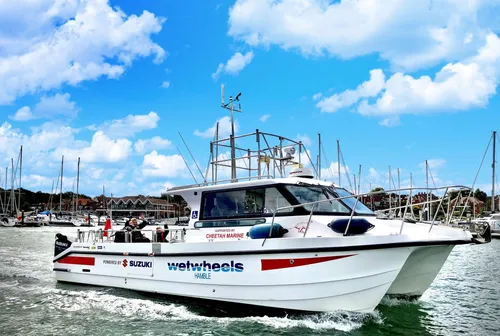
Above the wreck, Major Harcourt sat in the SBS fast boat wheelhouse. His team moved with habitual ease, turning tension into competent action. Harcourt’s face was composed, a habit of command. He scanned thermal overlays, small motor signatures, GPS pings leading to the wreck. He had orders: watch, do not provoke. Observation without escalation was the boundary he enforced, a living rule.
The SBS employed multiple surveillance tools, none affording certainty, but together producing persuasive patterns. Acoustic buoys listened for irregular sounds; low-orbit drones provided impressionistic imagery; human eyes filled gaps with careful thoroughness.
Harcourt saw six cold signatures circling the wreck. The moment’s elasticity tightened. “Eyes only,” he whispered into a throat mic. “No intercept unless the device is visible or team in danger.” A clipped affirmative returned.
Beneath the surface, Petrov and Kor worked in focused silence, affixing, masking, validating with recorded images stored in packs. They left nothing overt; attachments sat shunned by seabirds and insignificant in the dark. With the final camera blink, they sealed pouches, reattached jet packs, and prepared for withdrawal.
Sokolov allowed himself slender approval, adequate in his mind. “We leave no trace.” He thought ahead two moves: letters, communiques, political storms. To have placed the devices was to invest in a future act.
Harcourt pressed his jaw against his fist, watching the patterns: finished task, quiet withdrawal. His duty was to translate patterns into evidence ministers could use without calling for blood. He collected every frame, buoy reading, and camera capture, preserving chain of custody.
The night contained a different violence: the decision to place instruments beneath a wreck, creating a latent threat. The Montgomery lay sleeping, renamed in none of its parts, a hull now a conditional hazard. The Russians had achieved their objective: discrete placement, minimal disturbance, successful withdrawal.
Petrov watched the horizon, aware that his compliance with orders carried comfort and unease. Kor allowed a small inward smile, not triumph, but recognition of correct execution. The personal and operational worlds remained separate: photographs, kits, lives untouched by the river’s judgement.
The SBS observed silently. Harcourt logged the acoustic signatures, shapes in the water, patterns of behaviour. He would not escalate; decisions on neutralisation belonged to ministers, diplomats, legal authorities. Delay could leave a device in place; action could trigger the calamity they sought to prevent. He felt the weight of the decision as a physical object, recording every frame with bureaucratic precision.
Sokolov drove away, pitying the Montgomery, bracing for political weather. He had invested an option into the state’s portfolio. The night ended without violence beyond the incision of intent. The river accepted their movements as if designed to swallow small transgressions. The SBS preserved what the night had offered, translating it into evidence.
On the riverbed, devices slept like patient predators, known only to those who placed them and those now holding proof. Their activation potential hovered like a legal clause: unrealised until written into action. For the participants, the night was an exercise in discipline and moral compromise. Each would wake with that knowledge heavy in their bones.
The river kept flowing, indifferent. The estuary would make of the night what it did of all human acts: carrying away some things, keeping others in its bed, altering the coastline of consequence. The Montgomery remained where she had always been, but now she bore a quiet danger, a potential to be interpreted as defence or menace depending on which hand signed the document.



This story has not been rated yet. Login to review this story.